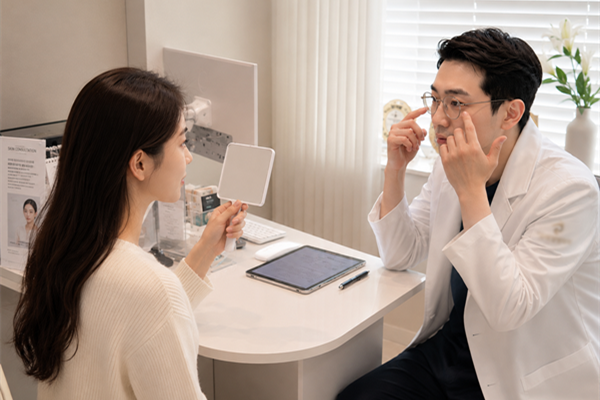
If you’ve been following Korean aesthetic trends, you’ve likely noticed a pivot: Hyaluronic acid (HA) fillers are losing momentum, while facial fat grafting is reclaiming the spotlight. This isn’t just a trend; it is a fundamental shift in aesthetic philosophy from “filling” to “restoring.”
The “Overfilled” Fatigue
Over the past decade, HA fillers have been the go-to for instant volume. However, long-term or high-volume usage often leads to the “overfilled face” syndrome—a stiff, unnatural look where the skin seems tight, but the expressions lack vitality. Many patients are now seeking to dissolve old fillers, fueling a market-wide demand for more natural, autologous (self-tissue) solutions.
Why Fat Grafting?
Unlike synthetic fillers, fat grafting uses your own tissue, offering several key advantages:
Zero Rejection: Since it’s your own tissue, there is no risk of allergic reaction or foreign body rejection.
Natural Integration: Grafted fat “lives” in the face, moving naturally with your expressions without the “lumpy” feel of fillers.
Regenerative Effects: Modern techniques incorporate stem cells, which improve skin quality, texture, and radiance.
Longevity: While fillers need maintenance every 6–12 months, surviving fat cells provide a long-term, often semi-permanent result.
2026 Technical Advancements
Early fat grafting suffered from unpredictable survival rates and calcification. New techniques have increased survival rates from 30–50% to 60–75%+:
Nano Fat: Ultra-refined fat processed into tiny particles, perfect for delicate areas like tear troughs and fine lines.
SVF (Stem Cell) Technology: Concentrating stem cells from the fat to stimulate tissue regeneration.
Micro-Droplet Injection: Applying fat in small, layered amounts to ensure uniform distribution and prevent nodules.
Common Treatment Areas
Tear Troughs / Under-eyes: Fills hollowness without the “Tyndall effect” (bluish tint) associated with fillers.
Temples: Softens sharp contours for a more youthful, rounded facial shape.
Cheeks / Apple Zone: Restores lost volume caused by aging or fat loss.
Nasolabial Folds / Corners: Smoothes lines while maintaining facial mobility.
Recovery Reality Check
Fat grafting requires more commitment than fillers:
Immediate Post-op: Significant swelling and light bruising are expected for 3–5 days.
Social Downtime: You will generally need 1–2 weeks before looking “normal” in public.
Final Results: Full stabilization takes 3–6 months.
Travel Advice: If flying to Korea, stay for at least 5–7 days post-procedure to ensure initial recovery before your flight.
Fat Grafting vs. Fillers: Quick Comparison
| Feature | Fat Grafting | HA Fillers |
| Duration | Long-term (Permanent portion) | 6–18 months |
| Natural Feel | Very Natural | Depends on skill/amount |
| Recovery | 1–2 weeks | Minimal / None |
| Predictability | Survival rate varies | Highly predictable |
| Cost (Korea) | ₩2M – 5M | ₩300K – 1.5M |
Many top Korean surgeons now use a “hybrid approach”: using fillers for structural support and fat grafting for overall volume.
FAQ
Where is the fat taken from? Usually the abdomen, thighs, or buttocks. Extraction volume is small and leaves minimal impact on daily life.
Is a second session needed? Potentially. “Touch-ups” (secondary injections) are common 3–6 months post-op if volume absorption occurs, and are usually much cheaper.
Can thin people get this? Yes, but supply is limited. Surgeons may use “Nano Fat” techniques for precision rather than large-volume filling.
Do weight changes affect the results? Yes. Grafted fat behaves like real fat—it may expand or shrink if your overall body weight fluctuates. Stability is key.
Conclusion
The resurgence of facial fat grafting marks a move toward “slow, sustainable aesthetics.” It is an ideal choice if you prioritize long-term, natural results and don’t mind a recovery period. When consulting in Korea, bring photos of desired outcomes and prioritize surgeons with a high volume of fat-grafting cases.