“I want to change my nose, but by how much?” Subjective descriptions have long been the primary cause of patient dissatisfaction in plastic surgery. Korean medical research is solving this with AI-driven consultations, shifting the focus from “vague feelings” to “objective data.”
Beyond Filters: What is AI Consultation?
Current AI systems used in top Korean clinics go far beyond simple beauty filters. They focus on four pillars:
Symmetry Analysis: Identifying specific deviations in facial balance.
Proportional Evaluation: Calculating key facial ratios (e.g., nose-to-face, eye spacing) against aesthetic standards.
Visual Age Prediction: Quantifying the “rejuvenation effect” of a procedure.
Pre- vs. Post-op Comparison: Using 3D modeling to objectively track surgical outcomes.
Research Progress
AI has shown significant breakthroughs, particularly in rhinoplasty. Recent studies from Korean university-affiliated hospitals indicate:
94% consistency between AI and veteran surgeons in assessing nasal height.
87% accuracy in predicting post-op nasal tip projection.
3x increase in patient satisfaction when AI simulation is used during pre-op planning.
Note: AI provides objective data to support a surgeon’s decision—it does not replace the surgeon’s clinical judgment.
3D Scanning and Virtual Simulation
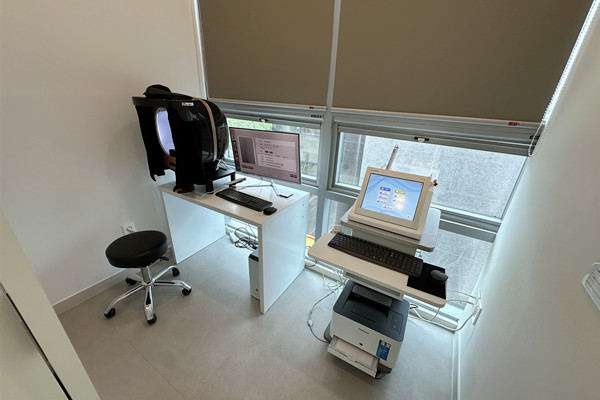
Most top-tier clinics in Gangnam now utilize 3D face scanners as a standard consultation step:
3D Modeling: A volumetric model of your face is generated to analyze symmetry and proportions.
Virtual Surgery: Surgeons perform a “virtual simulation” in real-time, allowing patients to preview potential results.
Objective Tracking: By scanning again 3–6 months post-op, patients can compare the true 3D morphological change against the pre-op simulation.
Quantifying Rejuvenation
AI deep learning models now assess “visual age.” While not an absolute science, it provides a measurable benchmark for anti-aging procedures:
Mid-face lifts: Average reduction of 5–9 years.
Blepharoplasty (Eyelid surgery): Average reduction of 4–7 years.
Rhinoplasty: Average reduction of 2–4 years (attributed to improved facial harmony).
Essential Considerations
The AI Limitation: AI evaluates structural proportions in a static state. It cannot fully account for skin texture, subcutaneous tissue thickness, or individual muscle movement.
Verify the Tech: Beware of clinics claiming “AI consultation” that simply use basic beauty apps. When booking, ask: “Which specific system do you use? Is 3D scanning equipment included in the consultation?”
Comparison: Services for International Patients
| Service | Prevalence (Est.) | Fee Structure |
| 2D Proportional Analysis | 70–80% | Usually free |
| 3D Face Scanning | 30–50% | Often free (some charge ₩50k–150k) |
| Visual Age Prediction | 15–25% | Usually part of post-op care |
| 3D Virtual Simulation | 40–60% | Usually free (consultation tool) |
FAQ
Does AI-detected asymmetry mean I need surgery? No. Slight asymmetry is normal. AI detects it; a surgeon determines if it is clinically significant enough to warrant correction.
Are 3D simulations 100% accurate? No. They are “navigational guides,” not guarantees. Individual tissue healing and skin elasticity will cause minor variances.
Can I do this remotely? Many clinics offer remote 2D photo analysis for preliminary advice, but precise 3D simulation requires an in-person visit.
Does it increase surgery costs? Generally, no. Most high-end clinics bundle these tools into their standard consultation process.
Final Takeaway
Data-driven consultations have made the Korean aesthetic industry more precise and transparent. However, AI is a tool, not a decision-maker. It is a bridge for communication, while the surgeon remains the master of the final result. When planning your trip to Korea, utilize these tools to align expectations, but prioritize a board-certified surgeon who can translate those data points into a successful surgical outcome.