Are you noticing subtle changes—a slight loss of fullness in your apples, deepening tear troughs, or a general loss of facial support? You aren’t imagining things; this is “mid-face aging.” In Korea, a growing trend among 30-somethings is to proactively address mid-face sagging through surgical intervention, rather than waiting for the heavy-duty facelifts required later in life.
Mid-Face Aging: Why It Happens
The “mid-face” (from the lower eyelid to the nose) is the anchor of facial youth. As early as age 25, fat pads start to atrophy and descend. Ligaments weaken, causing the apple of the cheek to slide downward, deepening nasolabial folds and tear troughs. When you are in your early 30s, you may be in a “gray zone”—too saggy for fillers to look natural, but not yet saggy enough for a traditional facelift.
Traditional Facelift vs. Mid-Face Lift
Traditional Facelift: Longer incisions, targets broad areas, more invasive. Recommended for ages 45+.
Mid-Face Lift (Endoscopic/Minimally Invasive): Uses small incisions hidden in the hairline or inside the mouth. It precisely targets the descent of fat pads and SMAS fascia. It is the “lightweight” version of a facelift, designed for early intervention.
The Korean Approach: Endoscopic Mid-Facelift
The most popular procedure for the 30-40 age group is the Endoscopic Mid-Facelift:
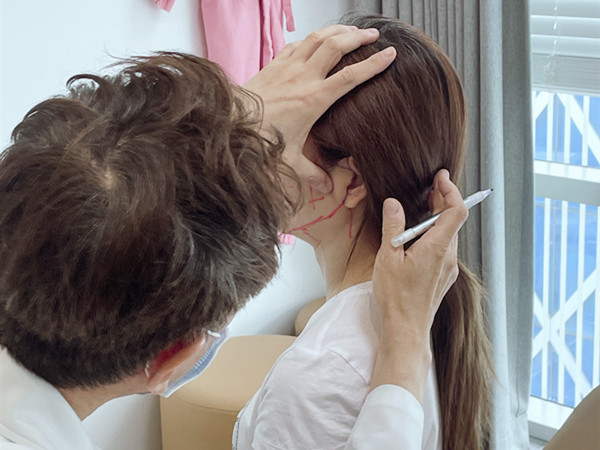
Precision: 3–5 small (1cm) incisions in the temporal hairline.
Method: A tiny endoscope allows the surgeon to visualize tissue, release ligaments, and lift the cheek fat pads back to their youthful position.
Results: Visible, natural lifting with minimal scarring. The procedure takes 1.5–3 hours under sedation or general anesthesia, with a 2-week recovery period.
Am I a Candidate?
Ideal Candidates: Noticeable cheek descent, deep tear troughs, and nasolabial folds caused by sagging rather than skin laxity. A key test: If gently pushing your cheeks upward makes you look 5+ years younger, you are a prime candidate.
Not for: Those with severe skin laxity, significant neck sagging (may require traditional lifts), or those who rely on excessive filler volume without dissolving it first.
Pricing Estimates in Korea
| Procedure Type | Approx. Price (KRW) | Recovery Time |
| Endoscopic Mid-Lift | ₩5M – 8M | 2–3 weeks |
| Mid-Lift + Temporal Lift | ₩7M – 12M | 3–4 weeks |
| Mid-Lift + Fat Grafting | ₩8M – 14M | 3–4 weeks |
Note: Budget for a 10–14 day stay in Seoul for follow-ups.
Why “Natural” is the Korean Standard
Korean aesthetics prioritize a “naturally youthful” look—not “operated.” The goal is to restore the apples of the cheeks to their original position without creating an unnatural, “perpetually smiling” expression. This level of finesse requires a Board-Certified Plastic Surgeon (성형외과 전문의). Always verify the surgeon’s credentials before booking.
FAQ
How long does it last? Typically 5–10 years, significantly longer than non-surgical energy devices like Ultherapy.
Will my facial structure change? No. The goal is restoration to your youthful baseline, not a transformation. If you look like a different person, the lift was likely too aggressive.
Is 30 too young? Not if the structural sagging is present. Early intervention is often less traumatic and yields better, more natural results than waiting.
Can I start with Ultherapy? Yes. It is a reasonable “test” to see how your skin responds. If energy treatments fail to provide the desired lift, surgery is the logical next step.
What about scars? Small incisions are hidden in the hairline; they fade significantly within 2–3 weeks.
Final Advice
Mid-face lifts are not a “one-size-fits-all” solution. If you feel like your face is losing its “support,” consult a board-certified plastic surgeon in Korea to assess your aging baseline. Early intervention is a proactive strategy to maintain your natural appearance without the need for drastic, high-risk procedures later on.
Disclaimer: This information is for educational purposes and does not replace professional medical advice. Always consult a licensed specialist to discuss surgical risks.