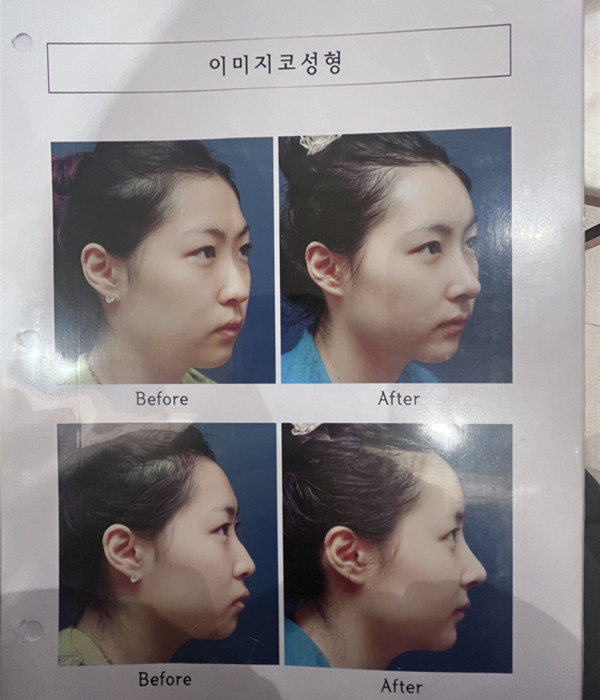
The truth is that most rhinoplasty failures aren’t due to poor surgical skill, but poor preoperative planning. According to a 2025 Seoul survey, complaints regarding rhinoplasty center primarily on communication gaps (40%) and opaque pricing (35%), rather than medical complications. Here are three common “traps” to avoid:
Trap 1: The “Celebrity Template” Fallacy
A nose is not a standalone part; it must harmonize with your specific facial bone structure, forehead height, and chin proportions.
The Fix: Use 3D-CT simulation tools (like Face ON) to design a nose based on your specific nasofrontal (ideal: 115°–130°) and nasolabial (ideal: 90°–95°) angles. Don’t chase a celebrity’s look; chase your own facial harmony.
Trap 2: Prioritizing Price over Material Quality
Significant price disparities in Korea often hide compromised safety:
Red Flags: Omitted 3D-CT scans, procedures performed by interns rather than lead surgeons, or uncertified implants.
Market Price Guide (Approximate):
Silicone: ₩3M–5M (~NT$7.2k–12k)
Rib Cartilage Complex: ₩8M–15M (~NT$19k–36k)
3D-Printed Custom Implant: ₩5M–9M (~NT$12k–21.6k)
Revision Rhinoplasty: ₩10M–20M (~NT$24k–48k)
Advice: Be extremely wary of rib cartilage surgeries priced below NT$40,000.
Trap 3: Overlooking Rib Cartilage “Memory”
Autologous rib cartilage is popular for its natural feel and lack of rejection, but it carries a risk of warping (bending) over time.
The Fix: Look for surgeons utilizing “anti-warping” techniques or advanced technology like the INNORIB method (using 3D-printed molds to shape the cartilage), which significantly reduces the deformation rate to under 5%.
Quick Material Comparison
Silicone: Mature, affordable, reversible, but carries risks of transparency and capsular contracture.
Gore-Tex: High integration, natural feel, but extremely difficult to remove later.
3D-Printed Implants: Perfectly customized via CT scan, lowest risk of shifting/transparency, but expensive and requires a 3–4 week lead time.
Rib Cartilage: Zero rejection, most natural, but requires an extra incision and carries a slight warping risk.
Korea Rhinoplasty Timeline
1–2 Months Prior: Online consultation & photo assessment.
Day 1–2: In-person consultation & 3D-CT scan.
Day 3: Surgery (3–5 hours, typically under sedation).
Day 4–7: Suture removal & initial recovery.
Day 8–10: Final review before flying home.
Recovery: Avoid glasses for 1 month; avoid smoking, alcohol, and spice for 3 months. Full stability takes 6 months.
FAQ
Are 3D-printed implants better? Yes, for fit and stability, but they aren’t suitable for all cases (e.g., severe deviated noses).
Does rib cartilage always warp? No, but it has a risk. Expert surgeons can keep this under 5%. Always ask how many cases your surgeon has performed.
When can I have a revision? Wait at least 6 months after the initial surgery for tissues to stabilize. Revisions are more expensive and difficult, so “get it right the first time.”
How long should I stay in Korea? 7 to 10 days is optimal.
Disclaimer: This information is for reference only. Individual needs vary; always consult with a board-certified plastic surgeon.